

Urban Planning (MUP)
Shape Livable Communities
The Master of Urban Planning (MUP) prepares graduates for careers in city planning, transportation, housing, environmental planning and economic development through hands-on studio courses and real-world internships. Students choose concentrations in Community Development or Sustainability while developing expertise in planning analysis, policy and urban design. With evening and part-time options for working professionals and accelerated pathways for undergraduates, the program builds the technical skills and ethical foundation needed to create equitable, sustainable urban solutions.

Course Catalog
Interested in accelerating your education? Current UofL undergraduates can apply graduate credits toward both a bachelor's degree and the MUP through the Soaring Scholars program. Full details are in the course catalog below.
Master of Urban Planning
Unit: College of Arts and Sciences (GA)
Department: Urban and Public Affairs
Program Website
Academic Plan Code(s): See Concentration Requirements tab.
Program Information
Fully accredited by the Planning Accreditation Board (PAB) and ranked #23 nationally according in Planning Educators in the 2012 Planetizen guide, the Master of Urban Planning (MUP) Program strives to play an important role in the University of Louisville's urban/metropolitan mission by creating the best possible learning environment for the student whose goal is to become a planning practitioner, by advancing the state of knowledge in the planning field through faculty research, and by bringing that knowledge to bear on the challenges facing the community.
The MUP Program prepares students to work in a wide variety of fields, including land use and environmental planning, urban design, historic preservation, transportation planning, community development, housing planning, economic development planning, real estate development, and sustainability. With the continuing expansion of Louisville and the nation's other metropolitan areas, urban planning is one of the leading professional fields in terms of demand and job satisfaction, according to surveys by Jobs Rated Almanac and the Encyclopedia of Careers and Vocational Guidance.
Students have the option to specialize in one of two concentration areas: community development or sustainability. Students have the opportunity to benefit from working on real planning problems through the required internship and studio courses. Studio courses are taught at the Urban Design Studio, located in downtown Louisville and operated by the MUP Program.
The degree requires 39 credit hours (two years of full-time study or the equivalent in part-time study), although up to six (6) credit hours of relevant graduate course work may be transferred into the program. Students may enroll on a part-time or full-time basis. Classes are held in the evenings to meet the scheduling needs of persons holding full-time jobs.
Accelerated BA/BS and MUP
Undergraduate students interested in the program's accelerated options should visit the catalog pages for the BA in Sustainability or the BS in Urban Studies for more information.
Degree Requirements
| Code | Title | Hours |
|---|---|---|
| Core Coursework | 18 | |
| Internship and Studio | 6 | |
| Concentration or Approved Electives in Non-Concentration Option | 15 | |
| Minimum Total Hours | 39 | |
Admission Requirements
Applicants must hold a bachelor's degree (any major is acceptable) and must submit two letters of reference (at least one from someone familiar with the applicant's academic abilities) and a statement of purpose. Graduate Record Examination (GRE) scores are recommended but are not required. Applicants whose native language is not English and who do not hold a degree from a university where the language of instruction is English must submit the results from an English proficiency exam. The minimum acceptable scores are
- 105 for Duolingo English,
- 79 for TOEFL before January 2026 and a minimum overall score of 4.0, with minimum sub-scores of 4.0 in each skill area, after January 2026
- 6.5 for IELTS, and
- 55 for PTE Academic.
Admission is competitive; successful candidates have a minimum undergraduate GPA of 3.0 (B).
An application form can be obtained from the Graduate School, all required application materials must be submitted including the application for admission.
Program Requirements
Master of Urban Planning Degree Program
| Code | Title | Hours |
|---|---|---|
| Urban Planning Core Courses | 18 | |
URBS 601 | Planning Theory & History | |
URBS 602 | Urban Economics | |
URBS 603 | Applied Research Methods | |
URBS 604 | Land Use & Planning Law | |
URBS 605 | GIS for Planning & Policy | |
URBS 606 | Site Planning | |
| Internship | 3 | |
URBS 610 | Internship and Professional Practice | |
| Capstone | 3 | |
URBS 620 | Capstone Studio | |
| Concentration Area (see tab for coursework) | 15 | |
| Minimum Total Hours | 39 | |
Juris Doctor/Master of Urban Planning Dual Degree Program
The Brandeis School of Law will allow students in the dual degree program to apply nine (9) credit hours of approved courses in urban planning as electives toward the JD degree. The Brandeis School of Law will accept each of these urban planning courses on a pass/fail basis, provided that the student earn at least a B (3.0) in the course. The following MUP courses are approved to be counted as electives toward the JD degree:
| Code | Title | Hours |
|---|---|---|
| URBS 601 | Planning Theory & History | 3 |
| URBS 614 | Transportation and Land Use Planning | 3 |
| URBS 672 | Mediation and Dispute Resolution | 3 |
| URBS 615 | Environmental Policy | 3 |
| URBS 662 | Public Budgeting | 3 |
| URBS 655 | Human Resources Management | 3 |
| URBS 651 | Foundations of Public Administration | 3 |
| URBS 624 | Urban Transportation Planning | 3 |
| URBS 621 | Housing and Community Development | 3 |
| URBS 622 | Historic Preservation and Sustainable Practice | 3 |
| URBS 611 | Real Estate Principles | 3 |
Any other MUP course approved by the Associate Dean of Student Life at the Brandeis School of Law, upon individual petition by a dual-degree student.
The urban planning program will allow students in the dual degree program to apply nine (9) credit hours of approved courses in law as electives toward the MUP degree. The urban planning program will accept each of these law courses on a pass/fail basis, provided that the student earn at least a C (2.0) in the course. The following JD courses are approved to be counted as electives toward the MUP degree:
- LAW 862 Administrative Law
- LAW 841 Energy Law
- LAW 931 Environmental Law
- LAW 820 Constitutional Law II
- LAW 807 Property II
- LAW 902 Real Estate Transactions
- LAW 839 Water Resources Law and Policy
- Any other JD course approved by the Director of the MUP Program in the School of Urban and Public Affairs, upon individual petition by a dual degree student.
In addition to the above cross-application of urban planning credits toward the JD degree and of law credits toward the MUP degree, students in the dual degree program shall be required to take URBS 604/LAW 904, a three (3) credit hour interdisciplinary course cross-listed in both law and urban planning. URBS 604/LAW 904 shall count as a three (3) credit hour graded elective toward the JD degree, and likewise shall count as a three (3) credit hour graded elective toward the MUP degree. To receive MUP credit, the student must earn at least a B (3.0) in the course.
Concentration Requirements
Community Development
Academic Plan Code(s): URPLMUPHCD
| Code | Title | Hours |
|---|---|---|
| Select five courses from the following: | 15 | |
URBS 613 | Real Estate Market Analysis | |
URBS 614 | Transportation and Land Use Planning | |
URBS 618 | Urban Design | |
URBS 611 | Real Estate Principles | |
URBS 667 | Budgeting and Finance | |
URBS 690 | Special Topics (Urban Justice & Policy) | |
URBS 624 | Urban Transportation Planning | |
| Minimum Total Hours | 15 | |
Sustainability
Academic Plan Code(s): URPLMUPSUS
| Code | Title | Hours |
|---|---|---|
| Select five courses from the following: | 15 | |
URBS 631 | Sustainability Theory | |
URBS 614 | Transportation and Land Use Planning | |
URBS 615 | Environmental Policy | |
URBS 641 | Urban Justice & Policy | |
URBS 632 | Sustainable Social-Ecological Systems | |
URBS 690 | Special Topics (Environmental Law) | |
URBS 690 | Special Topics (Water Resources Law & Policy) | |
SUST 703 | Land and Ecosystem Conservation | |
| Minimum Total Hours | 15 | |
Non-Concentration Option
Academic Plan Code(s): URPLMUP, URPLMUPACC
| Code | Title | Hours |
|---|---|---|
| Electives | 15 | |
Five Urban Planning electives (excludes core requirement courses) | ||
| Minimum Total Hours | 15 | |
The Master of Urban Planning program prepares students to meet the requirements for certification and/or licensure. If you plan to pursue professional licensure or certification you should first determine your state’s criteria for examination and licensure to see how/if our program meets those requirements prior to enrollment. We recommend that you also contact your state’s licensing board directly to verify that the requirements have not changed recently and to answer any questions especially those regarding additional requirements beyond the degree.
More information about certification or licensure is available at the following website: https://louisville.edu/about/departments/academic-planning-accountability/disclosures/professional-licensure.
For programs with an online option, more information about certification or licensure is available here:
https://online.louisville.edu/resources/compliance/license.
Master of Urban Planning Public Information
The Office of Academic Planning and Accountability at the University of Louisville requires that all academic programs identify expected student learning outcomes (SLO), assesses the extent to which these outcomes are achieved, and provide evidence of improvement when necessary. The Master of Urban Planning program divides students into two cohorts:
- Year 1 Cohort: Students enrolled in the program in Fall 2024 or Spring 2025,
- Year 2 Cohort: Students enrolled in the program in semesters prior to Fall 2024.
The MUP Core Curriculum Committee (MUPCCC) is responsible for annual SLO assessment. This committee includes all instructors who regularly teach one or more core courses. This committee follows the PAB guidelines evaluates student achievement on three learning outcomes (Knowledge, Skills, Profession Ethics). For each outcome area, there are expected sub-areas. The evaluation of each sub-area is based on a scale of 3-- SP (Strong Pass), 2 -- P (Pass), and 1 -- NP (No Pass).
| Learning Outcome | Measure | Target | AY 2024-25 |
Knowledge – The program shall provide students with a foundation in the evolution of urban planning as a discipline and the knowledge necessary to apply urban planning methodologies to contemporary urban development processes. Students should demonstrate knowledge in the following areas:
| The MUPCCC evaluates each sub-area of planning knowledge, based on a scale of 3-- SP (Strong Pass), 2 -- P (Pass), and 1 -- NP (No Pass), for every student. Based on available scores of all sub-knowledge areas, an overall score is calculated for every student as the average of his/her sub-knowledge area scores. | 90% of students have an overall score higher than 2 (indicating pass or strong pass). | 100% for all students. |
Skills – The program shall provide students with a strong foundation of the research methods common to the field of urban planning and allied professional fields. Students are expected to be equipped with skills of planning and allied professional fields, in the areas of:
| The MUPCCC evaluates each sub-area of planning skills, based on a scale of 3-- SP (Strong Pass), 2 -- P (Pass), and 1 -- NP (No Pass), for every student. Based on available scores of all sub-knowledge areas, an overall score is calculated for every student as the average of his/her sub-skill area scores. | 90% of students have an overall score higher than 2 (indicating pass or strong pass). | 100% for all students. |
Professional Ethics – The program shall Provide students with the opportunity to obtain professional work experience/ethics in planning and allied fields through an internship or practicum. Students should be exposed to a set of values and ethics and integrate these values and ethics into their course work and intern/practicum experience. These values and ethics include:
| The MUPCCC evaluates each sub-area of planning values/ethics, based on a scale of 3-- SP (Strong Pass), 2 -- P (Pass), and 1 -- NP (No Pass), for every student. Based on available scores of all sub-knowledge areas, an overall score is calculated for every student as the average all sub-area scores. | 90% of students have an overall score higher than 2 (indicating pass or strong pass). | 100% for all students. |
The Planning Accreditation Board, which oversees accreditation for all planning degree programs in North America, mandates that all accredited programs make publicly available the following information.
| 2025-2026 Tuition and Fees | |
| Kentucky Resident, Full Time, Academic Year | $17,104 |
| Kentucky Non-Resident, Full Time, Academic Year | $33,908 |
| Student Retention Rate | |
| Percentage of students who began studies in Fall 2024 and continued into Fall 2025 | 80% |
| Student Graduation Rate | |
| Percentage of students graduating within 4 years, entering class of Fall 2021 | 86% |
| Percentage of students graduating within 3 years, entering class of Fall 2022 | 80% |
| Percentage of students graduating within 2 years, entering class of Fall 2023 | 56% |
| Number of Degrees Awarded | |
| Number of degrees awarded for the 2024 - 2025 academic year | 5 |
| AICP Pass Rate | |
| Percentage of master’s graduates taking the AICP exam within 3 years who pass, graduating class of 2021 | 3 |
| Employment | |
| Percentage of all graduates obtaining professional planning, planning-related or other positions within 12 months of graduation, graduating class of 2024 | 100% |
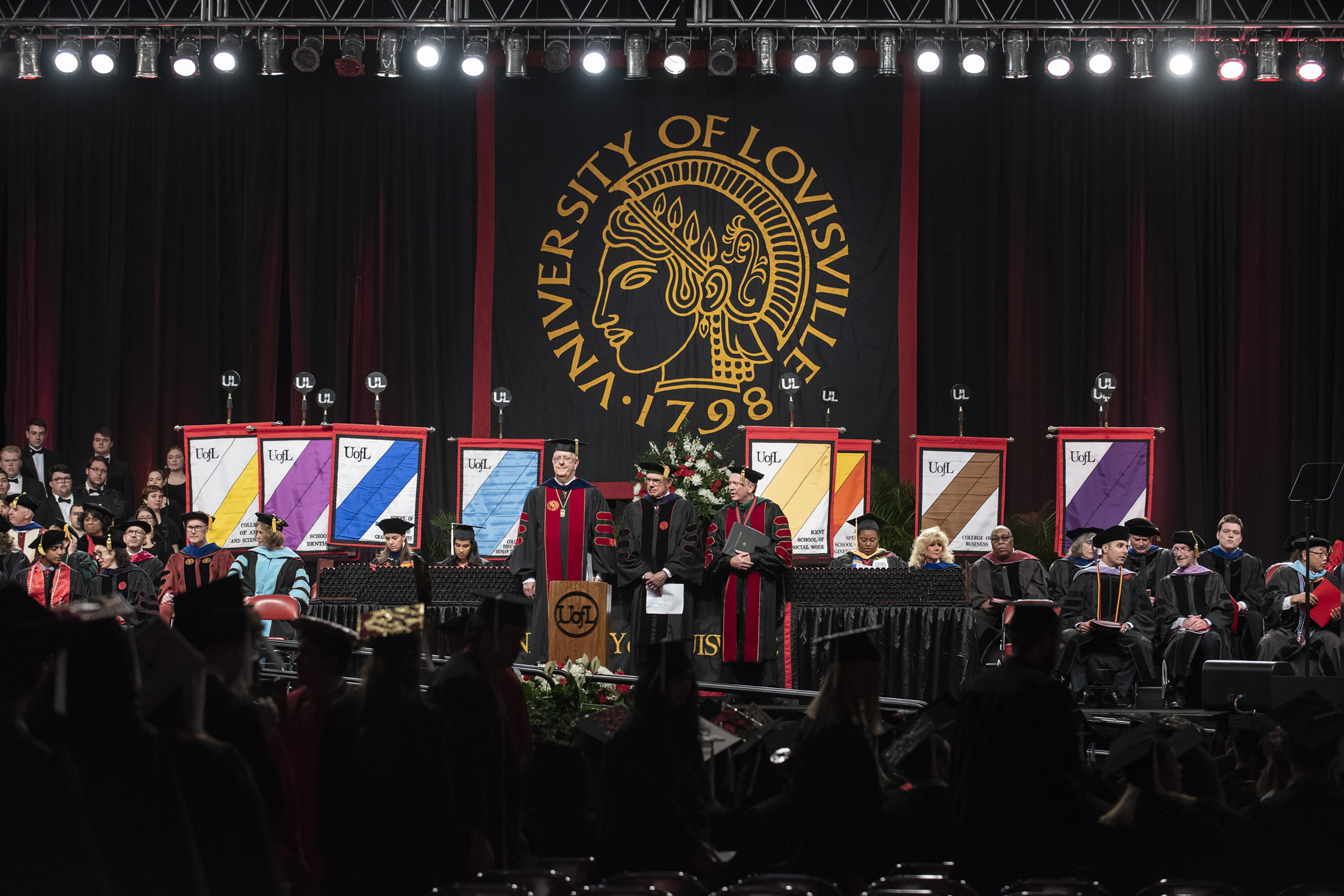
Build tomorrow's sustainable communities today
Ready to join the field with 95% employment rates and $83,720 median salaries? With cutting-edge CLUER research and our new Urban Studies program, your passion for community transformation becomes your pathway to extraordinary impact. From smart cities to climate resilience, your planning expertise shapes a sustainable future for all.
Related Degrees
