LOUISVILLE, Ky. – A new federal grant will strengthen efforts to teach Kentucky’s health professionals how to fight bioterrorism.
The two-year grant from the U.S. Health Resources and Services Administration is part of a national initiative to prepare doctors, nurses, dentists, pharmacists, veterinarians and others to act quickly and effectively should there be a bioterrorism attack. HRSA officials have announced that the University of Louisville will receive nearly $1.4 million of the total $26.6 million in funds being awarded in fiscal year 2003.
Public health, medicine, nursing and dentistry faculty at U of L will collaborate with faculty at the University of Kentucky and local and state public health officials to improve continuing education for bioterrorism preparedness, said Dr. Paul McKinney, project director and assistant director of U of L’s Center for the Deterrence of Biowarfare and Bioterrorism.
“We have a unique combination of skills to apply to this project,” he said. “U of L is well versed in the medical aspects of bioterrorism, while UK is well versed in the agriculture, pharmacy and veterinary aspects.”
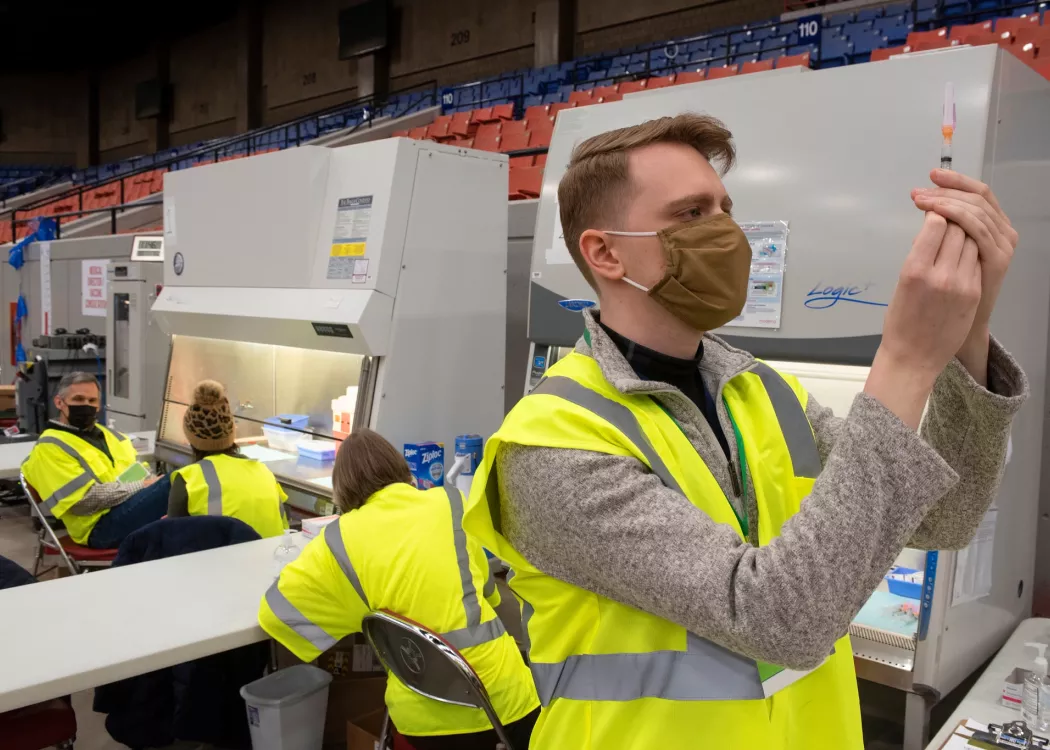
The grant will allow health professionals in rural Kentucky to receive training in bioterrorism preparedness for the first time through distance learning technology, McKinney said.
U of L has played a key role nationally in helping the country prepare for bioterrorism and biowarfare. It created a center with that focus in 2001 after anthrax scares erupted in Florida and Washington. U.S. Sen. Mitch McConnell (R-Ky.) helped secure $2.7 million in initial funding for the center through a federal Centers for Disease Control appropriation. Last fall, the center was designated by CDC as one of several specialty centers in the nation for public health preparedness.
So far, the center has trained more than 4,000 health and security professionals in the Louisville and Lexington areas how to cope with a bioterrorism attack. The center also has improved the way public health data is collected and analyzed.
“By teaming up with the University of Kentucky and public health officials around the state, we can pool our expertise and devote our best efforts to keeping Kentuckians safe from bioterrorism,” said U of L President James Ramsey. “It’s a good example of how higher education, working closely with the community, can tackle real, daily-life problems.”
McConnell said that he, too, was pleased about the additional federal funding.
“The people of Kentucky deserve first responders who are trained to recognize and respond to biological threats," he said. "I was pleased to earmark the initial federal funding for U of L’s bioterrorism center and I am proud that the federal government again has recognized U of L’s unique expertise in this field."