
Undergraduate Research
 |
Dr. Andrew WilsonDirector of Undergraduate Research(502) 852-9279 |
Discover Research in Chemistry
Click on a Link Below
Opportunity
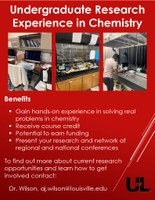
 Research lies at the fundamental core of the chemical sciences. Exposure, at the undergraduate level, to the research experience provides an invaluable look into the world of chemistry. Students enrolling in Chem 390WR, 391, 392, 491 or 492 may perform research on a broad array of topics, including analytical chemistry, biochemistry, inorganic chemistry, organic chemistry or physical chemistry. Students are strongly encouraged to discuss research opportunities with a variety of faculty prior to making a selection. See more details here. It is best to do this during the semester before you enroll in research. Students can also work with a faculty member outside the Chemistry Department. This requires this additional Agreement for Credit form. For more information, speak with your department advisor.
Funding
 Students may receive funding for their research efforts. Funding may derive from grants of individual faculty or students can apply to the Summer Research Opportunity Program.
Presentations
 Students may present their results at several venues, such as at Regional or National Meetings of the American Chemical Society. These venues provide students unique opportunities to develop their presentation skills, meet other scientists working in similar fields, and see future possibilities for their careers.
Publications
Undergraduate researchers can serve as co-authors on research publications. A few examples are shown below, with the undergraduates underlined.
"Sensitivity Enhancement of NIR Fluorescence Contrast Agent Utilizing Gold Nanoparticles”, K. A. Kang, J. Wang, M. G. O'Toole, M. H. Nantz, J. D. Moore, S. Laulhe, S. Achilefu Adv. Exper. Med. Biol. 2011, in press.
“Aminooxy Cationization Reagents”, S. Biswas, X. Huang, W. R. Badger, M. H. Nantz Tet. Lett. 2010, 51, 1727 - 1729.
"C-F Activation of Hydrofluorocarbons (HFCs) Mediated by Aluminum Reagents", M. Ali, Leping Liu, Bo Xu, G. B. Hammond Tet. Lett. 2009, 50, 4078 - 4080.
"Alkylation of a Dimolybdenum SO Bridge, Subsequent Reactions, and Characterization of the Thioperoxide Bridge", C. M. Tuong, W. K. Hammons, A. L. Howarth, K. E. Lutz, A. D. Maduvu, L. B. Haysley, B. R. T. Allred, L. K. Hoyt, M. S. Mashuta, M. E. Noble Inorg. Chem. 2009, 48, 5027 - 5038.
“Aminooxy Cationization Reagents”, S. Biswas, X. Huang, W. R. Badger, M. H. Nantz Tet. Lett. 2010, 51, 1727 - 1729.
"C-F Activation of Hydrofluorocarbons (HFCs) Mediated by Aluminum Reagents", M. Ali, Leping Liu, Bo Xu, G. B. Hammond Tet. Lett. 2009, 50, 4078 - 4080.
"Alkylation of a Dimolybdenum SO Bridge, Subsequent Reactions, and Characterization of the Thioperoxide Bridge", C. M. Tuong, W. K. Hammons, A. L. Howarth, K. E. Lutz, A. D. Maduvu, L. B. Haysley, B. R. T. Allred, L. K. Hoyt, M. S. Mashuta, M. E. Noble Inorg. Chem. 2009, 48, 5027 - 5038.
Faculty
Students are strongly encouraged to contact faculty and discuss current research opportunities in their labs.