
New Paradigm

by Dale Greer last modified Sep 20, 2008 04:55 PM
Contributors: Jeannie Bowman
— filed under: , ,

UofL's new Center for Environmental Genomics and Integrative Biology combines supercomputer power with multidisciplinary expertise to crack the code on complex interactions between the environment and the human body

New Paradigm

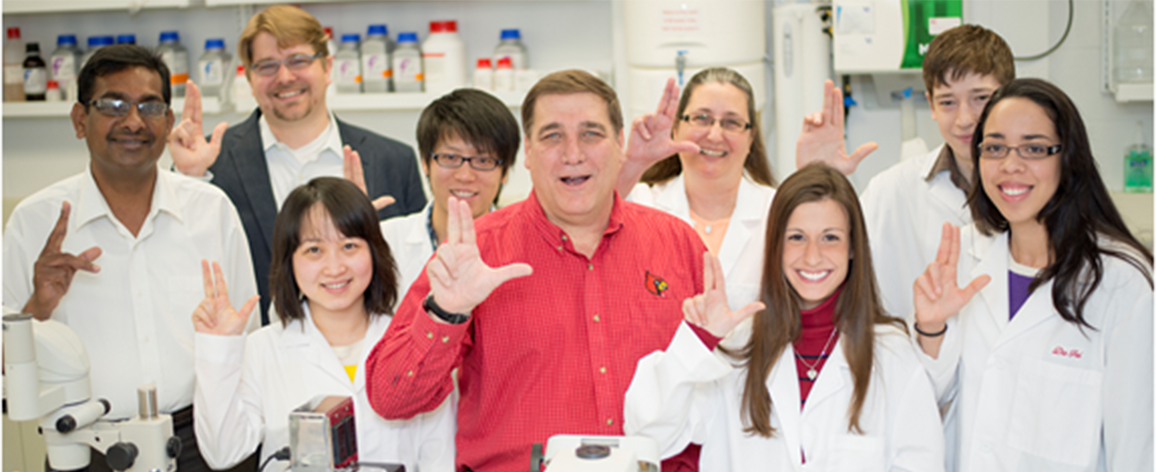
The center draws on a broad range of expertise from across the university. Its advisory board includes (seated, left to right) Irma Ramos, M.D., Kenneth Ramos, Ph.D., Susan Galandiuk, M.D., (standing, left to right) Qunwei Zhang, M.D., Ph.D., M.P.H., Arun

Everybody knows that smoking causes cancer. It just doesn't cause cancer in every body.

This curious state of affairs explains why George Burns could smoke cigars every day for 70 years yet die of old age at 100, while millions of other smokers have met a much earlier demise from cigarette-induced carcinomas.

Similar conundrums lie behind most other diseases caused by environmental factors, according to UofL researcher Kenneth Ramos, Ph.D. Some people develop specific diseases after exposure to toxic agents, while others do not.

The center draws on a broad range of expertise from across the university. Its advisory board includes (seated, left to right) Irma Ramos, M.D., Kenneth Ramos, Ph.D., Susan Galandiuk, M.D., (standing, left to right) Qunwei Zhang, M.D., Ph.D., M.P.H., Aruni Bhatnagar, Ph.D., Douglas Darling, Ph.D., Roland Valdes Jr., Ph.D., Russell Prough, Ph.D., and J. Christopher States, Ph.D. Not pictured is Nigel Cooper, Ph.D.

Scientists have known for years that this seemingly random distribution isn't random at all. It actually results from each person's genetic makeup. In other words, a person exposed to a toxin will develop an associated disease only if his genetic profile renders him biologically vulnerable - a condition known as genetic predisposition.

If, on the other hand, his genetic makeup is such that an environmental agent cannot interact with his biology to cause disease, he gets a pass. The science underlying this genetic crapshoot is maddeningly complex, Ramos says, because it likely involves interactions between multiple environmental factors and a host of genes - of which the human body has about 30,000.

That has made it extraordinarily difficult for researchers to understand true linkages between environmental exposure, genetic makeup and the onset of diseases like cancer.

"Historically, this work has been done by studying one gene at a time - and it could take maybe 20 years to understand how that one gene behaves in one person," says Ramos, a professor of biochemistry and molecular biology in the School of Medicine.

"But most chronic diseases are polygenic, so it's really been a black box. The only thing we truly know is what happens at the end stage, when a patient develops a disease. We still have little understanding of how complex interactions between multiple genes give rise to most of the degenerative diseases that affect us."

And the list of known, environmentally related diseases is growing. Besides such obvious afflictions as cancer and heart disease, it now includes disorders like diabetes and schizophrenia that may strike adults as a result of their exposure to environmental factors while still developing in their mothers' wombs, decades earlier.

Now, however, Ramos and about 25 other university scientists have a new tool to help unravel the complex mysteries behind gene-environment interaction - UofL's state-of-the-art Center for Environmental Genomics and Integrative Biology.

Established over the summer with a $4.4 million grant from the National Institutes of Health, the CEGIB brings serious resources to the table, including leading-edge supercomputers and expert guidance from multidisciplinary teams of geneticists, biostatisticians, mathematicians and epidemiologists who can help researchers design the most effective studies or interpret billions of resulting data points more accurately.

The new center employs state-of-the-art supercomputing clusters to analyze mountains of genetic data.

"This prestigious award places UofL among a handful of institutions like Harvard, Johns Hopkins and the University of North Carolina that are studying the specifics of gene-environment interaction with the goal of developing treatments and programs that will lessen the impact of environmental contamination," notes UofL President James Ramsey.

UofL's facility - one of just 22 NIH-designated environmental health centers nationwide - will focus on three areas in which the university has already demonstrated research leadership, says Larry Cook, M.D., executive vice president for health affairs.

These are:

  • Environmental cardiology (the study of environmental factors that cause heart disease)
  • Environmental carcinogenesis (the study of environmental factors that cause cancer)
  • The role of environmental pollutants on fetal development and the subsequent onset of diseases in adults

"Instead of studying these problems after the fact," Cook says, "the Center for Environmental Genomics and Integrative Biology will focus on what happens in the human body between an exposure to environ-mental contaminants and the development of disease, and it will translate those findings into new interventions and treatments for patients."

To support that mission, the center has developed three primary pools of expertise, a Bioinformatics, Biostatistics and Computational Biology Core; an Integrative Health Sciences Facility Core; and a Community Outreach and Education Core.

The first core will employ mathematical algorithms and computational analysis to help researchers sift through mountains of genetic data, says Ramos, the center's director and driving force behind its creation. The second will help translate research findings into new treatments or health interventions that can slow, halt or prevent diseases from developing. And the third will help educate disadvantaged and medically underserved communities at risk for environmental illness.

"This center is one of the few facilities worldwide that has the capacity and knowledge to integrate what we understand about genetics with what we know about environment in ways that allow us to comprehend the complexity of human illness," Ramos says. "I think we can make a huge difference in the way we think of disease, the way in which we translate that information into health interventions and the way in which we share our discoveries and knowledge with the community."

Crunching the Data

Researchers conducting environmental-exposure studies typically begin with a comparative analysis, Ramos says. They might, for example, expose a research subject to an environmental pollutant, take a tissue sample, and compare it to a control sample collected before the exposure.

The analysis would focus on "gene expression" - the way in which, for example, a gene regulates the production of a particular protein. The environmental exposure might cause a gene to increase the amount of protein that is produced, in which case the gene is said to "go up;" or it could reduce the level of protein, in which case the gene is said to "go down;" or it could remain unchanged.

Now multiply that analysis by 30,000 genes, run the test 100 times to account for variables like diet, and repeat the protocol on multiple subjects. The result is billions of data points and no easy way to search for patterns or clusters that might indicate interaction between multiple genes. That's why the center's Bioinformatics, Biostatistics and Computational Biology Core is so crucial, Ramos says.

"It would be impossible to do this work without computers because there is far too much data to sort out. But with mathematics in the equation, you can apply algorithms to stratify data sets into groups - for example, all the genes that went up during the experiment go in one group, all the genes that went down go in another, and so on. This lets you take the complexity of 30,000 genes and simplify, so you can understand what groups of genes are doing at a particular point in time.

"But what's really difficult is identifying and understanding relationships between genes that don't behave in the same way yet somehow are interrelated. Say, for example, that gene X always goes up when gene Y goes down and gene Z doesn't change. The computer can identify these relationships for you, revealing what might be invaluable information about disease progression.

"The synergy between molecular biology, medicine and computational biology is really what gives us the power to begin unraveling these processes."

But the Bioinformatics, Biostatistics and Computational Biology Core is more than hardware or software, says Nigel Cooper, Ph.D., the core's director. Perhaps more important are its people, who are experts in mathematical modeling, biostatistics, data analysis and computer science.

"It's very important that researchers understand what methods were used to generate data output because that information is dependent on the specific methods used to analyze it," says Cooper, vice chair for research in the Department of Anatomical Sciences and Neurobiology in the School of Medicine. "Our resident experts can help with that. They also can compare output from different programs and use their intellect to determine the best data set for a given analysis.

"You can't just push a button on a machine. The investigators have to be able to trust the process."

Bench to Bedside

All the scientific data in the world won't make much difference to the clinical enterprise without a translational effort, however, and that is where the CEGIB's Integrative Health Sciences Facility Core comes into play.

"I think we need to demonstrate the relevance of what is essentially publicly funded research," says David Tollerud, M.D., M.P.H., who co-directs the core with UofL biochemistry and molecular biology professor Roland Valdes Jr., Ph.D., senior vice chair of the Department of Pathology and Laboratory Medicine in the School of Medicine. "The public deserves to see some output beyond a scientifically interesting article. They expect to see improved human health."

David Tollerud, M.D., M.P.H., co-directs the center's Integrative Health Sciences Facilty Core.

To that end, the core offers a broad range of expertise in study design, epidemiology and medical ethics.

"Some of our researchers are basic scientists who aren't familiar with doing studies on human tissue, so one of the things we offer is access to senior-level researchers who can provide assistance in setting up experimental designs that would be relevant to testing human samples," says Tollerud, chair of the Department of Environmental Health Sciences in the School of Public Health and Information Sciences. "This is crucial for scientists who may never have worked outside the realm of a cell culture or animal model.

"Then, moving a step downstream, basic science researchers - at least those who have considered doing translational research - typically need help understanding how to best implement confidentiality requirements needed in human studies, so we offer that as a resource.

"Or a researcher may come to us and say he or she has identified a new biomarker that may detect cancer earlier and wants to test the theory in a human population. We can help set up a study design and arrange consultations with epidemiologists, public health experts and ethicists to ensure a successful study that takes into account the broad range of issues which need to be addressed before the first data set is collected."

One highly successful UofL researcher, Aruni Bhatnagar, Ph.D., appreciates the assistance, which he says will be "extremely helpful" as his lab begins to do more translational work.

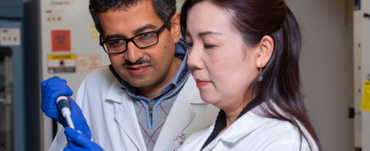
UofL researcher Aruni Bhatnagar, Ph.D., is examining the relationship between air pollution and heart disease with the help of the Center for Environmental Genomics and Integrative Biology.

Bhatnagar is the principal investigator in a five-year, $7 million NIH-funded study to examine the role of particulate air pollution in heart disease. Bhatnagar's team has discovered that certain classes of pollutants - aldehydes - affect heart disease in mice, but all the work to date has been done in a laboratory setting.

"The problem," he says, "is how to attach or assess a real-world significance to that. So we now are in urgent need of developing translational studies to test our ideas outside the laboratory.

"This center is going to be a very important component to our process as we go back to the field and look at exposed humans. For example, we could carry out epidemiological studies looking at population clusters of humans who were exposed to pollutants and see whether they bear a higher burden of heart disease. Or we could do panel studies - assess human exposures to these pollutants and see what the responses are. Either way, the center will help make our work much easier."

Bhatnagar just received an additional $1.5 million federal grant to collect, concentrate and characterize outdoor air in Louisville so researchers can identify its toxic components. He says he will be looking to the CEGIB for guidance in conducting subsequent epidemiological studies of the city's residents, which will be necessary to establish correlations between a particular pollutant, a particular disease and a particular genetic profile.

Another researcher who has already benefited from the center's expertise is Susan Galandiuk, M.D., a digestive health specialist and professor of surgery in the School of Medicine.

Galandiuk is interested in the relationship between exposure to cigarette smoke and digestive maladies like Crohn's disease or ulcerative colitis. Patients with these conditions have a three- to six-times higher risk of developing colorectal cancer compared to the general public.

"We know that smoking makes the symptoms of Crohn's disease worse, but it makes the symptoms of ulcerative colitis better," Galandiuk says. "What we don't know is if it's also associated with an increased risk of colon cancer. But there is definitely a profound effect of environment on these diseases."

To learn more, Galandiuk has been working with the CEGIB's facility cores to analyze data based on genetic samples that were voluntarily collected from her patients.

Susan Galandiuk, M.D., briefs a patient about a study examining the links between smoking and digestive disorders like Crohn's disease and ulcerative colitis.

"The data is so statistically complex there is no way we would be able to undertake these studies without the tremendous support the center is providing," she says.

Galandiuk also has been trying to identify a correlation between ulcerative colitis patients with colorectal cancer and particular genetic profiles - a finding that could be used to identify patients who are predisposed to developing cancer.

"Right now, we're identifying cancer in ulcerative colitis patients by doing a colonoscopy every year to look for colon cancer," she says. "And unfortunately, even with those exams, every year some people still develop cancer. That just shows you the method we're using now - while better than no screening at all - isn't that good.

"Ultimately, a genetic test for cancer predisposition would be wonderful because we could conduct more frequent exams on at-risk patients, do preventative surgery or prescribe medications that might reverse these trends and make the patients less likely to develop cancer."

Serving the Community

The third center core is directed toward outreach and education, with an emphasis on community-based participatory action plans for medically underserved populations, says core director Irma Ramos, M.D.

The physician, who led a similar effort at Texas A&M University, has chosen a large Hispanic community in Shelby County, Ky., as her first target audience, but the core's efforts eventually will be expanded to include other disadvantaged groups.

"Our goal is to educate the entire community on genetics, environmental factors, diseases and culture," she says. "All four factors interact with each other, and you have to target all of them together to be able to improve health."

For example, the doctor recalled from her experience in Texas that many of the residents in the community she targeted there didn't understand the connection between open fires and breathing disorders. As a result, they burned trash near their homes every day, causing children to suffer from asthma attacks.

"We educated them about the situation, and they arranged for a person in the community to collect trash once a week and take it to the dump for proper disposal," she says.

"Those are the kinds of things we're talking about. The message is simple, but the science behind it is complex."

The physician currently is building relationships with members of the Hispanic community and plans to hire up to four people who can serve as community lay health workers, she says. They will assist in the presentation of educational programs and will collect data for a community health survey.

"We want the community to participate in all aspects of the project, including decision-making on which topics to include for intervention," she says. "It will be a door-to-door kind of activity, which is very gratifying work. When people see that we want to sit down with them and help, they understand that they really do count. And once we empower the community by providing education, disease prevention will take care of itself."

Irma Ramos, M.D., talks with a group of Hispanic residents during a community event in Shelby County, Ky. She is working to build relationships as part of the center's outreach and education efforts.

Disease prevention, of course, is one of the primary goals of the Center for Environmental Genetics and Integrative Biology, and it has the potential to permanently alter the practice of medicine.

"In the past, all we in the medical community could do was offer generic advice to patients: 'Don't smoke'," says Chris States, Ph.D., deputy director of the center. "But people would always point to the George Burnses of the world as a rationale to defend their lifestyles.

"Because of genetic research, we now know that if a smoker has a specific gene variation, he will get emphysema," adds States, whose own work examines the effects of arsenic-contaminated drinking water on developing fetuses.

"The science is clear. Soon, I believe we will be able to offer similar counseling for a wide range of diseases, tailored to an individual's specific genetic makeup, because we will have done the research and have the knowledge.

"The best way to cure cancer or heart disease is never to get it. Prevention is the new paradigm, and that's one of the things we're working toward here with the resources the center is providing to researchers."

The CEGIB's director, Kenneth Ramos, shares States' enthusiasm about the promise of future advancements.

"We are now embracing complexity and social interactions in ways that can result in true progress for the treatment and prevention of disease," he says. "This is a tremendously exciting opportunity. The sky is the limit in terms of what we will be able achieve here at UofL."

Document Actions
Personal tools