University of Louisville School of Medicine

BACK TO THE FUTURE
A UofL research team led by Fred Roisen, Ph.D., has developed a breakthrough adult stem-cell therapy that repairs spinal-cord damage in paralyzed rats

Story by Dale Greer, photos by Tom Fougerousse

Stem cells are one of the most tantalizing discoveries of the scientific age.

Micro in size but macro in scope, they constitute the raw materials from which our bodies are made, with the amazing potential to become any type of tissue -- bone, muscle, brain -- if grown under precisely defined conditions.

Stem cells occur naturally in fertilized embryos as part of normal developmental processes, and they transform into the appropriate tissues at the appropriate times -- a process known as differentiation -- because of complicated chemical signals and environmental factors that researchers around the world are working to understand.

UofL researcher Fred Roisen, Ph.D., observes
a rat walking a tight rope following the rat's
treatment with a new adult stem-cell
therapy. Prior to treatment, the rat was
unable to maintain its balance because
of paralysis in its left forepaw.
The hope is that if scientists can control the process in a lab, they can create healthy replacement tissue on demand, eliminating a host of chronic and debilitating maladies, restoring nervous-system functionality lost to diseases like Parkinson's and Alzheimer's -- even growing whole new organs to replace diseased livers or kidneys.

Despite their alluring potential, stem cells are controversial because much of the research involves tissue harvested from embryos. That work is necessary if scientists ever hope to understand and replicate the natural development process, says Fred Roisen, Ph.D., chair of the Department of Anatomical Science and Neurobiology at the University of Louisville.

But stem cells also occur naturally in adults, and it is with these adult stem cells that Roisen's six-member research team has made a remarkable series of breakthroughs.

Using stem cells derived from tissue surgically collected from an adult person's nose, Roisen's team has been able to significantly repair spinal cord damage in paralyzed rats. Their achievements, published most recently in the March 2006 issues of Stem Cells and Brain Research, are especially noteworthy because spinal cord damage has proved notoriously difficult to treat; there currently are no clinically effective therapies.

"If someone five years ago had said, 'You're going to take cells out of a human nose and put them into an animal with paralysis of its arm, and you're going to cure that,' I would have said it was fantasy," Roisen notes. "But this isn't science fiction. It's really within our grasp. And I think that's so incredibly exciting."

Additional studies must be done to further characterize the treatment, and human trials are still several years away, but Roisen's initial findings are intriguing, other researchers say.

"There are a number of questions that need to be answered before we can use this approach clinically, but it is a very promising first step," says Scott Whittemore, Ph.D., scientific director of the Kentucky Spinal Cord Injury Research Center at UofL. "The animal models clearly showed significant recovery."

The work of Roisen's team is so promising that the university has applied for a patent to protect its system of harvesting and culturing nasal stem cells, more accurately known as human adult olfactory epithelial-derived stem cells. The patent also covers the team's techniques for lineage restriction (a process by which certain chemicals, genetic factors and environmental considerations progressively restrict the kinds of tissues the stem cells can become) and surgical reimplantation.

Roisen's ultimate goal is commercialization of the process, which was co-developed with UofL researchers Kathleen Klueber, Ph.D., and Chengliang Lu, M.D. To that end, the three scientists recently formed RhinoCyte Inc., a bio-tech start-up that has so far raised $930,000 in seed money with the help of MetaCyte, a Louisville biomedical business incubator.

Kathleen Klueber, Ph.D., and Chengliang Lu, M.D., co-developed with Roisen the processes by which adult nasal stem cells are harvested, cultured and reimplanted in patients.
The Kentucky Seed Capital Fund invested $260,000 in RhinoCyte, leading the initial round of investments. Other investors include the Queen City Angels, The Kentucky Science and Technology Corp., the Bluegrass Venture Fund, the Bluegrass Angels and several Louisville-based Angels.

"If we can successfully commercialize this technique, the worldwide implications would be tremendous," Roisen says.

A 'Eureka' moment

Roisen had been thinking about stem cell science throughout much of the 1990s, when the vast majority of research was being conducted on the embryonic variety.

But Roisen wanted to follow a different path by investigating adult stem cells. He also thought it would be prudent to deal exclusively with neural disorders, in part because they might be simpler to treat.

"Diseases of the nervous system generally target or damage a very specific population of cells," Roisen explains. "The beauty and excitement of the stem cell is that you could, in theory, grow a specific population and use it to replace only those damaged cells."

Roisen also wanted to work with autologous tissue. In other words, he wanted to remove adult olfactory stem cells from a patient, culture them to make healthy populations of the needed cells, and reimplant them in the same patient.

The advantages of autologous tissue are "phenomenal," he says, because they avoid the whole issue of histocompatibility.

Any cells transplanted from one person to another -- even stem cells -- must be matched for compatibility between donor and recipient, and the recipient must take a lifetime course of immunosuppressive, anti-rejection medication, Roisen says.

The transplanted tissue would need to be screened for viruses, too.

"If, however, you take your own cells and put them back into yourself, these issues no longer exist," Roisen says. "There's no need for immuno-suppression. There's no waiting list. There's total histocompatibility. And we don't have to screen for viruses, because you already have those viruses anyway."

The one problem with Roisen's plan was that invasive surgery would be required to collect the kind of adult stem cells he needed, since they reside only deep in the brain, the spinal cord or in similarly restrictive environments.

Or so he thought, until one day in the late 1990s when Roisen was lecturing at UofL on olfactory epithelial cells, which provide us with our sense of smell.

"It was a 'Eureka!' moment," Roisen recalls. "The light bulb went on, and I realized that these cells are one of the few places in the human body where a neuron is exposed to the environment."

That made it a simple matter to collect samples by feeding an endoscope up a patient's nasal passage to retrieve a small piece of tissue. The process could, in fact, be conducted on an outpatient basis by any otolaryngologist.

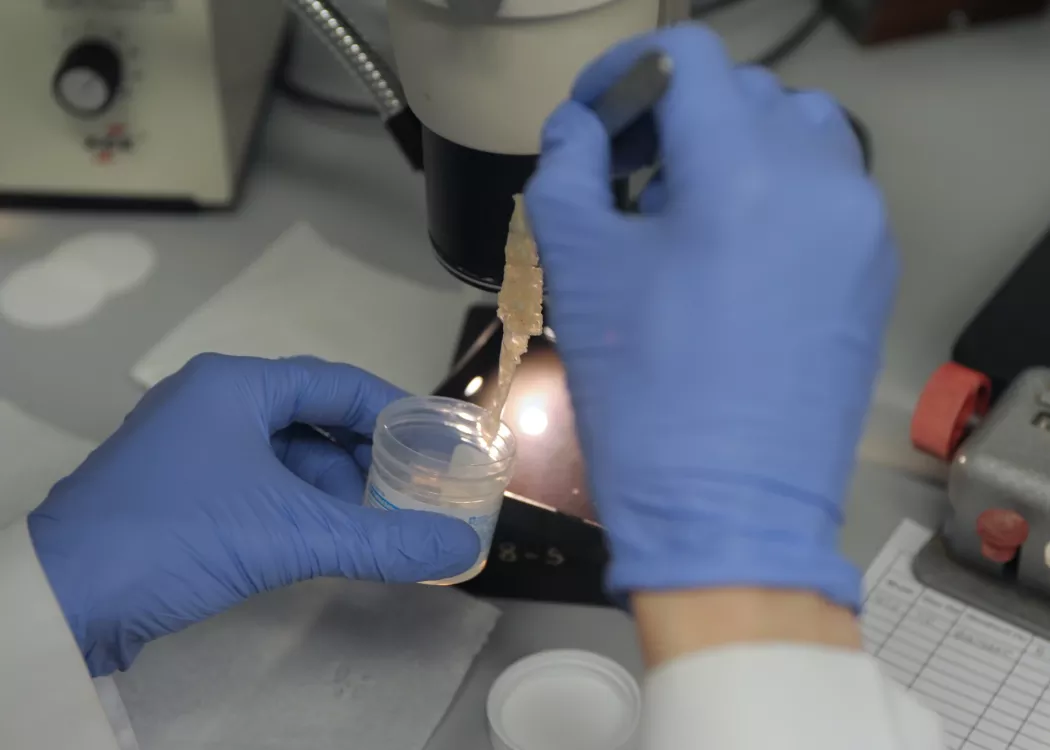
Roisen examines human adult olfactory-derived stem cells at his lab on the Health Sciences Center campus.
With a newly defined sense of direction, Roisen's group immediately set to work examining adult olfactory stem cells. They published their first significant paper in 2001, showing that they could harvest adult olfactory stem cells from a cadaver, grow them in culture and sustain growth indefinitely.

During the ensuing five years, the group secured more than $3 million in research funding from a variety of sources, including the National Institutes of Health and the Kentucky Spinal Cord and Head Injury Research Trust.

The group continued investigating and characterizing adult olfactory stem cells, using tissue collected from living patients with their consent during elective sinus surgery performed by UofL ear, nose and throat surgeon Welby Wimstead, M.D. And they went on to publish eight significant papers in scientific journals like Experimental Neurology and Brain Research, detailing their groundbreaking work with adult stem cells.

Repairing paralysis

Perhaps their most compelling research, however, was published this year in the journal Experimental Neurology, in which the group described how they restored functionality in partially paralyzed rats.

This effort differed from earlier researchers' work because the Roisen team wasn't trying to replace damaged tissue with new cells. Rather, they were trying to create an environment in which the rats' own tissue regenerated itself.

The UofL researchers began by making small cuts to the spinal cords of rats, severing the neural pathway that allows the animals to use their right or left forepaws. In double-blind tests, they then implanted two kinds of materials. One group received a gel-like substance infused with human adult olfactory stem cells, while the other group received the same gel-like substance without stem cells.

The results were remarkable.

"Within four weeks, we started to see some use of the paw in the group that received the stem cells," Roisen says. "Within 12 weeks, there was 80 to 90 percent recovery."

One of the tests for recovery involved placing the rats on a rope and observing their balance as they tried to walk.

"Rope walking is a very sensitive assessment," Roisen says. "The rats really need all four paws, but if one of them has a problem, it throws off their whole balance. And when we compared these two groups, we found that the presence of the human cells facilitated rope walking dramatically. There was almost complete recovery."

Subsequent anatomical studies demonstrated that the human cells formed a biological bridge, spanning the cut in the spinal cord and establishing "guide wires" that allowed the rats' own cells to regenerate along them, thus making functional reconnections.

The human cells also produced neurotrophic factors -- chemicals that promoted regeneration in the rats.

"We created a permissive environment," Roisen says of the transplanted tissue. "From a skeletal point of view, it was a biological bridge. The stem cells said to the rats' own neurons, 'Here's a road. Take this route. And not only that, we'll give you the gas along the way.' "

RhinoCyte initially will be focused on developing this very research into human applications using autologous tissue, in part because the current lack of treatment options for spinal cord injury means that regulatory obstacles are far less cumbersome for new spinal cord therapies.

But the company hopes eventually to expand its efforts to include treatments for Parkinson's Disease, Lou Gehrig's Disease and a host of other neural disorders.

Roisen's six-member research team benefits from the efforts of two support staff and UofL ear, nose and throat surgeon Welby Wimstead, M.D., (far left).
The group's most recent work, published in Stem Cell and Brain Research, provides strong evidence that olfactory stem cells can be coaxed to become dopamine-producing cells -- the kinds of cells lost to Parkinson's Disease -- or motor neurons -- the types of cells affected by Lou Gehrig's Disease.

"It's wonderful to have been a basic science researcher, and suddenly seethat some of the research you've been doing potentially has an enormous translational benefit," Roisen says.

"I can't tell you what it's like, at this stage in my career -- and I've been teaching for 40 years -- to suddenly be on the doorstep of something so terribly exciting. This truly has the potential to impact people all over the world."

All research conducted with animal subjects at the University of Louisville is approved by the Institutional Review Board and the Institutional Animal Care and Use Committee.

The University of Louisville is accredited under the Public Health Service's Policy on Humane Care and Use of Lab Animals, the United States Department of Agriculture Animal and Plant Health Inspection Service and the Council on Accreditation of the Association for Assessment and Accreditation of Laboratory Animal Care.